Picture credits
The drawings are our own. The photos are from Wikimedia Commons, under Creative Commons licences (Attribution, or Attribution-ShareAlike), CC0, or in the public domain.
Photos
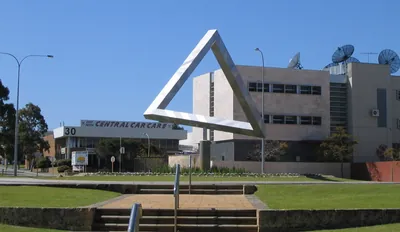 ImpossibleTriangleEastPerth gobeirne.jpg
by Greg O'Beirne, CC BY-SA 3.0. Cropped and resized; no other changes. Shared here under the same licence.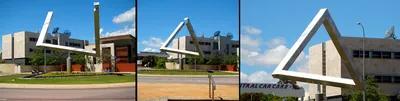 Perth Impossible Triangle.jpg
by Bjørn Christian Tørrissen, CC BY-SA 3.0. Cropped and resized; no other changes. Shared here under the same licence.
Our own drawings
- An impossible triangle drawn in three shades of purple and orange: three square bars meeting at three right-angled corners in a closed loop that cannot exist in 3D
Our own drawing - An impossible triangle built from a chain of small cubes, as Reutersvärd drew it
Our own drawing - Three straight square bars: a long bar along the ground, a second bar at right angles to it, and an upright bar whose top stops short of the first bar, leaving a gap
Our own drawing - A square ring of stone-coloured steps on tall purple walls: going round clockwise every step seems to go down, and the ring closes up on itself
Our own drawing - A line drawing of a fork: three round prongs at the top whose six lines run down and join, at the bottom, into the U-bend of two square bars
Our own drawing - The same devil’s fork, with the U-bends at the bottom picked out in orange
Our own drawing - A Necker cube: a wire-frame cube drawn with all twelve edges showing, so either square could be the front
Our own drawing - The Necker cube with the lower-left square shaded as the front face
Our own drawing - The Necker cube with the upper-right square shaded as the front face
Our own drawing - A wire cube where one edge of the back square, picked out in orange, passes in front of the top edge of the front square
Our own drawing - A cube frame made of twelve square beams, drawn normally
Our own drawing - The same cube frame, but a back upright beam appears in front of the front top beam
Our own drawing - On isometric dot paper, draw the outer outline in orange: a big triangle with its three tips cut off, so it has six sides. Each side runs along a line of dots.
Our own drawing - The outline from step 1 in dark ink, with a smaller triangle in orange inside it: the hole in the middle.
Our own drawing - The outline and hole in dark ink, with orange lines added that split each bar into two faces and form the three corners.
Our own drawing - The finished impossible triangle, with each face shaded light orange, mid purple or dark purple
Our own drawing - An isometric dot grid you can draw on, with an optional faint guide of the impossible triangle
Our own drawing - An impossible triangle: three square bars joined at right angles in a loop
Our own drawing - Three straight bars, one standing up, with a gap between the top of the upright and the end of the long bar
Our own drawing - A wire cube with the front square drawn over the back one
Our own drawing - A wire cube where one back edge passes in front of a front edge
Our own drawing - A cube frame of twelve square beams, each beam behind the ones nearer to you
Our own drawing - A cube frame of square beams where a back upright appears in front of a top beam at the front
Our own drawing - A fork with three round prongs at the top that turn into two square bars at the bottom
Our own drawing - A square ring of steps that seems to climb all the way round and arrive back where it started
Our own drawing
The drawings are simplified teaching drawings, not to scale, made from the sourced descriptions on this site. Useless the eraser is the network’s own mascot. Fonts: Bricolage Grotesque, Newsreader and Kalam (SIL Open Font Licence), served from this site.