Impossible objects you can visit
You can’t build an impossible triangle. You can build something that looks exactly like one, from one spot.
How this site works. Every fact is in our own words and linked to its source, beside it. Where good sources disagree, we show each version in a “Sources differ” box. Every drawing is our own.
The Impossible Triangle, East Perth
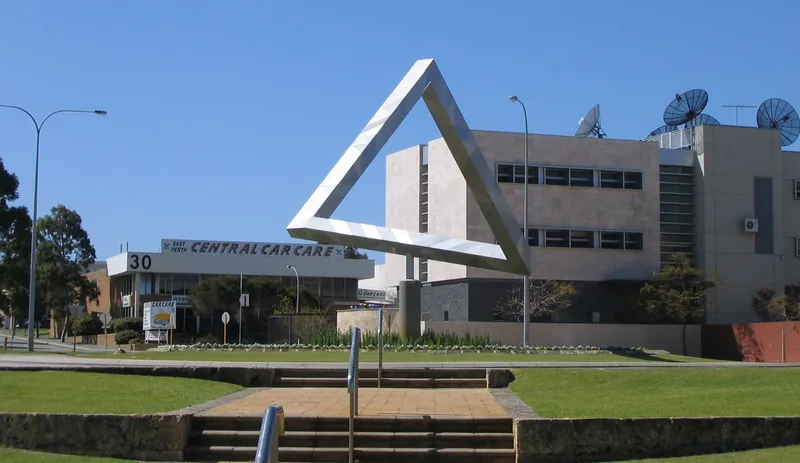
The Impossible Triangle in East Perth, Western Australia, is by the artist Brian McKay and the architect Ahmad Abas. DENMAC It stands 13.5 metres high. DENMAC
McKay and Abas submitted their design for the commission in 1997. DENMAC It was completed in November 1999. DENMAC
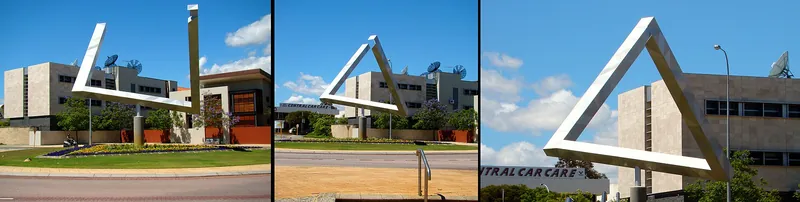
Western Australia’s planning minister unveiled it on 5 November 1999. WA Government, 1999 The minister said it can only be fully appreciated by moving around it to watch the shape change and the illusion appear. WA Government, 1999
The local art trail calls it the 13.5 m landmark at the gateway to East Perth. Claisebrook Art Trail It was part of the East Perth Redevelopment Project, which turned 38 hectares of industrial land into a new suburb. DENMAC
Its polished striations reflect sunlight and street light, changing look between sunrise and sunset. DENMAC
Sources differ: whose idea, and where?
- The minister’s statement called it an adaptation of a concept developed by Lionel and Roger Penrose in 1954. WA Government, 1999
- The makers say it was inspired by the Penrose triangle “first articulated” by Oscar Reutersvärd. DENMAC
- The local art trail says the triangle was devised by Sir Roger Penrose in the 1950s, and that there are only two spots from which it looks complete. Claisebrook Art Trail
- The WA Public Art Inventory gives its location as the roundabout where Royal Street, Brook Street and East Parade meet. WA Public Art Inventory
- The Illusions Index puts it in Claisebrook Square, and says it was chosen as the winning entry in a competition. Illusions Index
For the record: the Penroses published their paper in 1958, after seeing Escher’s 1954 exhibition, and Reutersvärd drew the shape in 1934. Every source describes the same sculpture; they just name its spot differently.
Sources differ: one viewing spot or two?
- The local art trail says the triangle was devised by Sir Roger Penrose in the 1950s, and that there are only two spots from which it looks complete. Claisebrook Art Trail
- In 1968 Richard Gregory made a wooden object that looks like a real impossible triangle from one position only; from anywhere else it is clearly three joined struts. Illusions Index
Gotschuchen, Austria
A 4-metre Penrose triangle by the association Treffpunkt Physik stands in Gotschuchen, St. Margareten im Rosental, Austria. Wikimedia Commons Its beams don’t actually meet at the top. Only from one viewing angle do they seem to join. Wikimedia Commons
Gregory’s wooden triangle
In 1968 Richard Gregory made a wooden object that looks like a real impossible triangle from one position only; from anywhere else it is clearly three joined struts. Illusions Index
Turn our version yourself in the find-the-angle toy.
An impossible waterfall
In 2011 a German design student known as mcwolles built a wooden copy of Waterfall’s water path, which seems to run uphill. Michael Bach Bach explains one of its tricks: the shape only looks impossible from one single viewing angle. It is made of two Penrose triangles. Michael Bach
On screen
Monument Valley, a 2014 game from Ustwo Games, is built around impossible figures. Illusions Index
The Penrose stairs appear in Christopher Nolan’s 2010 film Inception. Escher in The Palace
Next: draw your own →